
Get to know more about your teacher, his career, and the role of storyboarding.
The Art of The Storyboard with Lyndon Ruddy
Creature Art Teacher Course
Learn cinematic storytelling through professional storyboarding techniques.
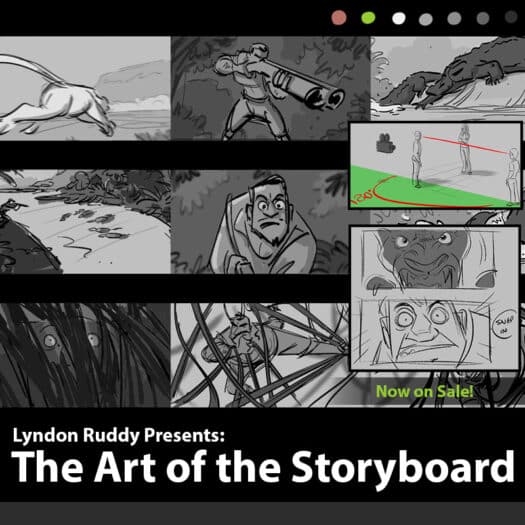
Join Lyndon Ruddy for an in-depth course on storyboarding for animation and film.
You’ll learn how to stage scenes, compose shots, communicate action, direct the viewer’s eye, and create storyboards that support story, pacing, and emotion.
Storyboarding
Visual Storytelling
Cinematic Composition
With Lyndon Ruddy
Visual Storytelling
Cinematic Composition
With Lyndon Ruddy
What You’ll Learn
Explore shot composition, camera language, staging, continuity, acting, and pacing for stronger visual storytelling.
Story Through Images
Learn how storyboards communicate emotion, action, character performance, and narrative clarity before animation begins.
Course Journey
Follow Lyndon through storyboard demonstrations, scene breakdowns, practical exercises, and professional production workflows.
Meet Lyndon Ruddy
Learn from veteran storyboard artist and visual storyteller Lyndon Ruddy, known for his work in feature animation and entertainment.
Lessons
01 Course Overview & Storytelling Process
Lyndon talks about types of storytelling and the relation between the story artist, the narrative, and the story.
02 Cuts & Shot Selection
Learn about visual storytelling and some parameters for deciding shots and cuts.
03 Framing, Eye-line & The rule of Thirds
Revise key concepts to position characters in and around the right part of the frame.
04 The 180 Rule & Camera Angles
Lyndon explains a fundamental rule to avoid disorienting your audience.
05 Using Camera Angles for Mood & Power
Learn how to use camera angles to express character mood and power.
06 Simulating the Moving Camera – Horizontal and Vertical Pans
See Lyndon simulating a moving camera to get horizontal and vertical panoramics.
07 The Moving Camera – Crane and Dolly
Simulate in your storyboards the swing down or swing up of the camera.
08 The Moving Camera – Push-Zoom-Snap
Lyndon shows you different ways to create a sense of 2D depth, and the circumstances in which they are recommended.
09 The Moving Camera – Traveling Pan/Tracking Shots
Evoke a continuous movement of the camera and learn when to use them.
10 Cinematic Staging & Framing
Learn about cinematic staging, composition, and framing.
11 My Story Process
Follow an exercise while you know Lyndon’s story process approach and how he craft his sequences.
12 Thumbnailing A Sequence – Part 1
Start the process of storyboarding the thumbnail stage.
13 Thumbnailing a Sequence – Part 2
Continue thumbnailing the sequence, while learning tips about storyboard drawing.
14 Final Boards – Part 1
Lyndon demostrates his technical process to flesh out the previous thumbnails into more detailed frames.
15 Final Boards – Part 2
Keep in eye on the clarity of your boards to transmit the story point.
16 Final Boards – Part 3
Lyndon closes the course reminding you the impact of storyboarding in the storytelling process. Share your artwork with #StoryboardWithLyndon #LyndonTutorial